Example 1.2
Takeaway point 1.2: A Statement of Facts should make the court want your adversary to lose. Use facts — not adjectives or rhetoric — to achieve that goal.
We see below two ubiquitous strategies: creating enmity toward an adversary and organizing your Statement around the elements that you need to establish in order to prevail.
Viacom sued YouTube, alleging that YouTube had infringed its intellectual property rights by allowing users to post copyrighted music, TV programming, and movie clips. The district court granted summary judgment for YouTube, holding that the relevant federal law (the Digital Millennium Copyright Act) contained a statutory “safe harbor” that shielded YouTube from liability: merely knowing that infringement was occurring was insufficient to establish liability. On appeal, Viacom argued that YouTube could not invoke the safe harbor because YouTube’s infringement was willful and profitable. This excerpt from Viacom’s Statement is organized around the elements of that argument and portrays YouTube as a greedy company willing to violate copyright law to achieve quick growth and easy profits.Source: Viacom’s brief in Viacom International, Inc. v. YouTube, Inc., 676 F.3d 19 (2d Cir. 2012) (some citations removed).
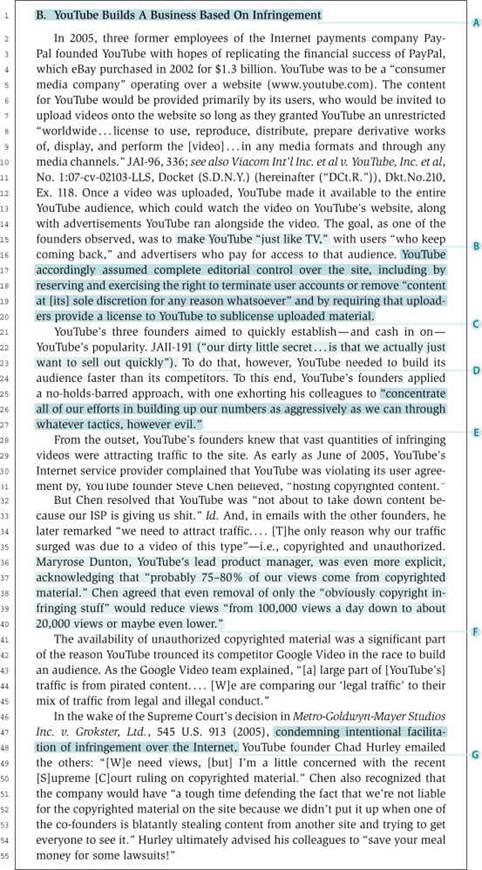
 Here, an argumentative heading tells readers exactly what they should expect to take away from this section. Headings need not be neutral.
 This excerpt analogizes YouTube to television just in case judges haven’t used YouTube. Moreover, it seems obvious that a TV network would be liable if it broadcast another network’s shows. By implying that YouTube is just like a TV station, Viacom taps into this intuition, to suggest that YouTube has infringed when it “broadcast” Viacom’s shows.
 Viacom builds its facts around the elements of its claims. For example, Viacom needs to prove that YouTube had control over its viewers’ videos; this paragraph thus emphasizes the sweeping license terms that YouTube imposed on users, the editorial control it exercised, and its power to terminate users. The next paragraph establishes YouTube’s intent to profit. And the one after that establishes that YouTube executives knew about the infringement on the company’s website. These facts track what Viacom needs to show to win and make YouTube sound venal.
 This parenthetical shows how to use the fruits of discovery. Viacom skewers YouTube with a document that YouTube produced during the litigation. This quote also enables Viacom to characterize all of YouTube based on a single e-mail from an unidentified author. This is a classic technique deployed by skilled lawyers: trying to paint multiple people (or an entire company) with the words of a single person. But use this technique judiciously: opposing counsel may point out your ruse, which can undermine your credibility.
 This quote might not even discuss copyrighted content, but Viacom nevertheless uses it, showing YouTube’s willingness to rely on “evil” tactics. Remember that litigation has no sense of humor: this line was a joke — Google’s motto is “Don’t be evil” — but on the naked page, it seems sinister and damning.
 Notice how powerful it is to use an adversary’s admissions. Coming from YouTube’s own executive, these quotations seem like irrefutable evidence of massive, perpetual infringement.
 The lawyers sneak some legal argument into their statement. Chapter 3 elaborates this technique.