Crisis and People
When a crisis comes, things change. By crisis, we mean major events with the potential to seriously threaten the company, maybe even its existence, and what is sometimes called “bet the company” or “bet the firm” issue.
The “Siemens-Crisis” (some 10 years ago) or the “Volkswagen-Crisis” are good examples of what we mean. These types of crises happen when internal processes designed to avoid certain “situations” fail. In this case, it seems that everything we've said above (or what is said about the perfect or modern structure of a legal function) no longer applies.Why is this? It seems to us that a crisis defies any process or plan. It was Helmuth von Moltke who said “no plan of operations extends with any certainty beyond the first contact with the main hostile force”, or, in a shorter version (and often attributed to Napoleon): “No battle plan ever survives contact with the enemy”.
Hence, when it comes to a crisis, i.e. to something which surpasses all processes regarding the value chain, our discussions on modern legal function structure etc. are not really helpful because they do not work in reality. Companies may train their people how to behave in a dawn raid, and it may even help nervous employees to act calmly, but it will not avoid the crisis.
In times of crises, we should not talk about B2B. What we have said about B2B is not applicable to the nervous CEO with regard to his function, or for helping the board to get it right when faced with an unfriendly takeover or an internal investigation. Advising board members in these situations is closer to B2C business, and here is room for all sorts of lawyers who are truly great and empathic advisers. Why B2C? Because the nervous CEO, or board members, are closer to a (sophisticated or informed) private customer who evaluates and appreciates lawyers' services. When things get tough, CEOs will not be calling the procurement department to help find the most cost-efficient lawyer.
In practice, this means that in certain situations the success of the legal function (and its external advisers) depends on the abilities of the people (lawyers, paralegals, other jurists etc.) to cope with and be able to read and understand situations, and to take or recommend appropriate decisions. What do these people look like, what is their profile? Recently, Jordan Furlong issued a paper “How to be a legal marvel”, describing the most important attributes and characteristics for successful professionals. He mentioned collaboration skills, customer service, emotional intelligence, financial literacy, process improvement, relationship building, technological affinity and time management—in short: leadership qualities. This is similar to research from the Bucerius Center on the Legal Profession done a couple of years ago on the most important areas in which successful lawyers, in-house or in private practice, have to excel: business acumen, ownership and legal management, accountability, rigour, risk and cost management.
Having said all this, what are the consequences? These are the key messages and takeaways for law firm managers or in-house legal department managers: companies will have to structure and organize their legal functions to respond to the hypotheses discussed above; and external providers of legal services will have to fit neatly into the value chain.
Note, however, that processes and structure won't save the company's life in a crisis. It is instead the human workforce that makes the difference.
Liquid Legal Context
By Dr. Dierk Schindler, Dr. Roger Strathausen, Kai Jacob
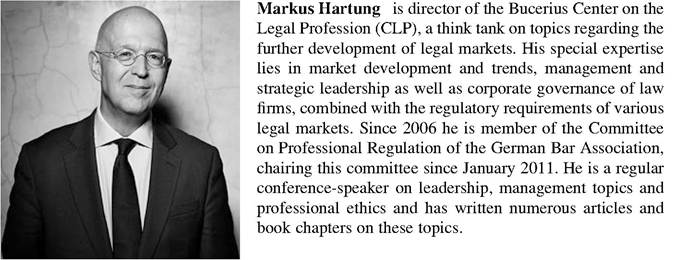
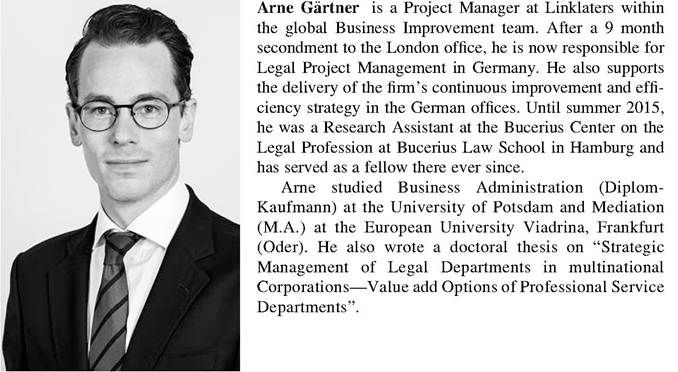
Hartung and Gartner provide a compact overview on the main forces that drive change in the legal market: Economic pressure, IT providing opportunities for automation as much as for collaboration and knowledge sharing, the decentralization of legal departments and the gravitation—or rather push—towards metrics-based performance management.
It is fascinating how the kaleidoscope of voices from forward thinking authors starts to paint a consistent picture around those four theses:
• On the economic pressure, we have had clear voices explain that and why it exists—starting with Fawcett in his foreword.
At the same time, Ross and Bassli have shown us means of getting a higher return on investment on every Euro that we spend on purchasing legal services.• As to the game-changing opportunities in modern legal tech, Bues and Matthaei have given us a concise overview on the opportunities that develop at ever increasing speed.
• On the trend to decentralize and up-level the legal human resources, we have heard Markfort introducing the polycentric approach in law firms, while Tumasjan and Welpe have shown us the way to develop an entrepreneurial DNA in a legal department.
• Pauleau, Roquilly and Collard have built a clear and tangible case for why and how to introduce a KPI-based performance management, while Meents has taken a stab at how law firms need to help clients to see the value in the services of a law firm, rather than remaining solely focused on the price-tag.
As we talk about the rapid and fundamental change in the ratio of external legal services that inhouse departments use and what we expect in terms of value for the money, the question arises: what is the best way to procure them? Mascello talks about how customers professionally procure legal services today.
Refererences
Barney, J. (1991) Firm resources and sustained competitive advantage. Journal of Management, 17 (1).
Morrison, R. (2008). Missing and elusive metrics. GC New York. http://gcnewyork.com/ columns08∕061908morrison.html.