Conclusion
Security and opportunity are not necessarily mutually exclusive. Even while the authors of this chapter welcome a shift toward a paradigm of opportunity, that new emphasis need not come at the expense of a secure foundation of contractual agreement.
Our chapter has demonstrated how employing the principles and methods of PPL—especially simplification, visualization, and collaboration—can enhance security and opportunity simultaneously.Advancing security and opportunity together in contracting is possible because PPL methods can transcend what causes security and opportunity to appear as inherently opposed: the traditional divergence in outlook, goals, and language between law and business. Framing contract goals as prevailing in court or limiting legal damages will emphasize standardized, litigation-tested disclaimers and indemnification clauses—exactly those terms that IACCM finds to be high on the agendas of many legally-focused contracts negotiators. A moment's reflection, however, reveals how stifling of opportunities those clauses are likely to be. They suggest on their face a mentality of self-protection through rigidity, and veiled threats to bring the power of the law against a contract partner—hardly an environment that encourages innovation.
In contrast is the business mentality that seeks stronger (and typically longer- enduring) economic and personal relationships with another party. A relational focus will expect occasional disruptions in contractual implementation. This focus will also accept the need to be flexible and accommodating, based on a reservoir of trust and long-term mutual benefit.
Although a relational mentality may be uppermost in the minds of those who negotiate the real deal, it is not often expressed in the paper deal. When economic and relational intentions are formalized into legal contracts, everyday language is translated and communications norms are transformed.
The agreements suddenly become inaccessible to non-experts—those who must implement the agreement as well as those who may have negotiated the deal. Furthermore, communication expectations may be disrupted, or rendered self-protective or suspicious—all in the name of ensuring legally “the security of contracts.” Little wonder, then, that security and opportunity appear opposed to one another. Where business and legal language and communication styles are so strongly compartmentalized, security and opportunity are never part of a shared agenda.In every realm of law, PPL methods seek a healthy integration of stronger personal engagement, attention to factual environments, and legal possibilities. PPL aims not only to prevent legal disputes by better long-range planning and design, but also to enable parties to reach individual goals, mutual benefits, and new opportunities. PPL examines the systemic, patterned interactions of people to uncover and explain recurring points of friction or lost value. It then suggests interventions by which the revealed dissonance is resolved—and often transcended toward greater possibilities.
So also in our examination of contracting: diagnosis of traditional patterns reveals lost value through failure of adequate communication, which in turn is caused by an exaggerated and unnecessary separation of business and legal professionals. The “treatment” suggested in this chapter is simplification and visualization of contracting language, plus the creation of collaborative structures and practices. If implemented, these PPL interventions may enhance security of agreements through greater understanding, flexibility and trust. Simultaneously, they can facilitate collaborative refinements and new business opportunities for each contracting partner.
Liquid Legal Context
By Dr. Dierk Schindler, Dr. Roger Strathausen, Kai Jacob
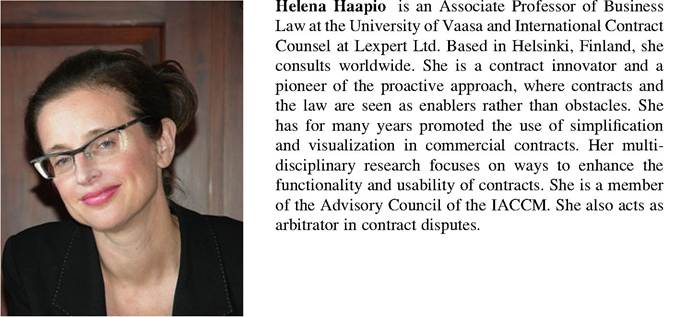
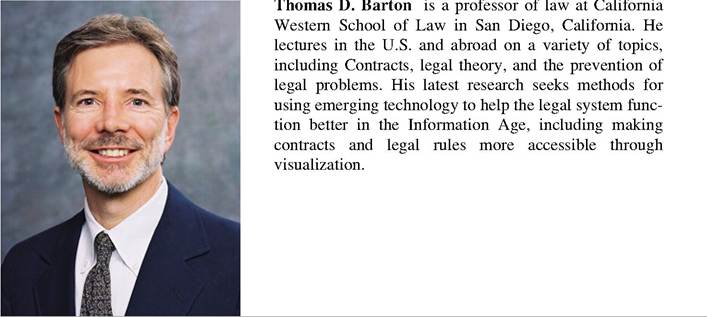
Haapio and Barton translate the sometimes abstract concept of lawyers needing to be more proactive, rather than only preventive, more opportunity rather than risk focused into the core of a lawyer's work: Contracting.
They pick up the growing demand on lawyers to view contracts less as a legal tool, but rather as a business tool. They then take us on a journey what contract drafting with the mindset of a business enabler can look like. While stating clearly that contracts today are centered (sometimes purely) around meeting legal standards, the authors leave no doubt that they are not making a case to sacrifice enforceability for the benefit of speed or ease of doing business.Taking the “10 pitfalls” in contracting, that IACCM has established by research, and pointing to the massive business value erosion that comes with them, Haapio and Barton establish a few common denominators that underlie those pitfalls: the need for simplified language and less self-protective clauses; the need to shift to a balance between preventive law and proactive law and thereby towards business friendly contracting.
Yet, what are the specific levers to pull? First, simplification is being called out and Haapio and Barton start with a call to action that lawyers should view themselves as designers who create rather a business tool than a contract. Second, visualization, as a technique to be used in contracts, aiming at making key information accessible to business stakeholders in an efficient way. Third, collaboration, meaning the simple idea that parties to a contract are better off thinking of themselves and acting as partners, rather than as adversaries.
As Haapio and Barton then point to very practical means of moving towards and implementing such a new way of contracting, it again becomes clear how interrelated the many aspects of the transformation in the legal industry are. Legal tech is the key to rise above the budget and efficiency pressure; at the same time it is the enabler to gain metrics that make a KPI-based performance management possible. In sum, this—when enabled by a professional legal operations function—allows for a truly new profile of a lawyer, who then must bring very different skills to the table than traditionally sought for.
Freeing the lawyer from the ghosts of the past will create space to embrace new concepts around business enablement—like simplification, visualization and collaboration in contracting.References
Barton, D. (2008). Using measurements to drive organizational value. Contracting Excellence, November 2008. International Association for Contract and Commercial Management IACCM. http://www2.iaccm.com/resources/?id=8030. Accessed 26 Sept 2016.
Barton, T. D. (2007). Three modes of legal problem solving-and what to do about them in legal education. California Western Law Review, 43, 389-416. http://works.bepress.com/thomas_ barton/10/. Accessed 26 Sept 2016.
Barton, T. D. (2008). A paradigm shift in legal thinking. Six contrasts of traditional and preventive/proactive legal thought. In H. Haapio (Ed.), A proactive approach to contracting and law (pp. 35-42). Turku, Finland: International Association for Contract and Commercial Management & Turku University of Applied Sciences.
Barton, T. D. (2009). Preventive law and problem-solving: Lawyering for the future. Lake Mary, FL: Vandeplas Publishing.
Barton, T. D. (2012). Collaborative contracting as preventive/proactive law. In G. Berger-Walliser & K. 0stergaard (Eds.), Proactive law in a business environment (pp. 107-127). Copenhagen, Denmark: DJ0F Publishing.
Barton, T. D. (2016). Re-designing law and lawyering for the information age. Notre Dame Journal of Law, Ethics & Public Policy, 30, 101-134.
Barton, T. D., Berger-Walliser, G., & Haapio, H. (2013). Visualization: Seeing contracts for what they are, and what they could become. Journal of Law, Business & Ethics, 9, 47-63.
Barton, T. D., Haapio, H., & Borisova, T. (2015). Flexibility and stability in contracts. Lapland Law Review, Issue 2, 8-28. http://www.ulapland.fi/InE.nglish/Units/Faculty-of-L.aw/Research/ L.apland-L.aw-Review/Issues/Issue-2,-2015. Accessed 26 Sept 2016.
Berger-Walliser, G. (2012). The past and future of proactive law: An overview of the development of the proactive law movement.
In G. Berger-Walliser & K. 0stergaard (Eds.), Proactive law in a business environment (pp. 13-31). Copenhagen, Denmark: DJ0F Publishing.Berger-Walliser, G., & 0stergaard, K. (Eds.). (2012). Proactive law in a business environment. Copenhagen, Denmark: DJ0F Publishing.
Berger-Walliser, G., Barton, T., & Haapio, H. (2017). From visualization to legal design: A collaborative and creative process. American Business Law Journal, 54(2) (forthcoming). Manuscript available at http://ssrn.com/abstract=2841030. Accessed 26 Sept 2016.
Bergman, J. (2015). 2015 top terms in negotiating - review & analysis - AMERICAS 2015. https://www.iaccm.com/resources/?id=8856 (for members only). Accessed 26 Sept 2016.
Brown, L. M. (1956). The law office. Apreventive law laboratory. University of PennsylvaniaLaw Review, 104(7), 940-953.
Clarity2010 Blog. http://blog.clarity2010.com. Accessed 26 Sept 2016.
Colquhoun, G. (2007, January). A clearer way to deal. The Journal, 45.
Creative Commons. (2015). About the licenses. http://creativecommons.org/licenses. Accessed 26 Sept 2016.
Cummins, T. (2015). Commercial excellence. Presentation at IACCM Finland event, Helsinki 14 September 2015.
Cummins, T., & Crawford, J. (2010, April 8). Collaborative contracting: Is it achievable? Webinar conducted under the auspices of IACCM. http://www2.iaccm.com/resources/? id=3446 (for members only). Accessed 26 Sept 2016.
Curtotti, M., & McCreath, E. (2012). Enhancing the visualization of law. Paper presented at the 2012 Law via the Internet Twentieth Anniversary Conference, Cornell University, 9 October 2012. http://ssrn.com/abstract=2160614. Accessed 26 Sept 2016.
Dauer, E. A. (1988, September). Corporate legal health: Preventive law dictates going to root causes to prevent claims from arising. Preventive Law Reporter, p. 12.
DiMatteo, L., Siedel, G., & Haapio, H. (2012). Strategic contracting: Examining the business-legal interface. In G. Berger-Walliser & K.
0stergaard (Eds.), Proactive law in a business environment (pp. 59-106). Copenhagen, Denmark: DJ0F Publishing.EESC. (2009). Opinion of the European Economic and Social Committee on ‘The pro-active law approach: a further step towards better regulation at EU level'. Official Journal of the European Union, 2009/C175/05, 26-33. http://eur-lex.europa.eu/legal-content/EN/TXT/ PDF/?uri=CELEX:52008IE1905&from=EN. Accessed 26 Sept 2016.
Ertel, D. (2004). Getting past yes: Negotiating as if implementation mattered. Harvard Business Review, 82(11), 60-68.
Etzkorn, I. A. (2011, August). Ten commandments of simplification. Center for Plain Language. http://bustthefacts.blogspot.fi/2011/08/ten-commandments-of-simplification.html. Accessed 26 Sept 2016.
Felsenfeld, C., & Siegel, A. (1981). Writing contracts in plain English. St. Paul, MN: West Publishing Company.
Haapio, H. (2006). Introduction to proactive law. In P. Wahlgren (Ed.), A proactive approach. Scandinavian studies in law (Vol. 49, pp. 21-34). Stockholm, Sweden: Stockholm Institute for Scandinavian Law. http://www.scandinavianlaw.se/pdf/49-2.pdf. Accessed 26 Sept 2016.
Haapio, H. (2013a). Good contracts: Bringing design thinking into contract design. In J. Chittenden (Ed.), Proceedings of the 2013 IACCM Academic Forum (pp. 95-136). Ridgefield, CT: International Association for Contract and Commercial Management. http:// www.iaccm.com/resources/?id=4958 (for members only). Accessed 26 Sept 2016.
Haapio, H. (2013b). Next generation contracts: A paradigm shift. Helsinki, Finland: Lexpert Ltd.
Haapio, H. (1998). Quality improvement through proactive contracting: Contracts are too important to be left to lawyers! Proceedings of Annual Quality Congress (AQC), American Society for Quality (ASQ), Philadelphia, PA, 52, May 1998, pp. 243-248.
Haapio, H. (Ed.). (2008). A proactive approach to contracting and law. Turku, Finland: International Association for Contract and Commercial Management & Turku University of Applied Sciences.
Haapio, H., & Passera, S. (2013, May 15). Visual law: What lawyers need to learn from information designers. VoxPopuLII Blog. Legal Information Institute, Cornell University Law School. http://blog.law.cornell.edu/voxpop/2013/05/15/visual-law-what-lawyers-need-to-learn-from- information-designers/. Accessed 26 Sept 2016
Haddad, S. (2013). Integration of law and contract management - Applying Contract visualization. In J. Chittenden (Ed.), Proceedings of the 2013 IACCM Academic Forum (pp. 52-73). Ridgefield, CT: International Association for Contract and Commercial Management. http:// www.iaccm.com/resources/?id=4958 (for members only). Accessed 26 Sept 2016.
Hetrick, P. K. (2008). Drafting common interest community documents: Minimalism in an era of micromanagement. Campbell Law Review, 30(3), 409-435. http://scholarship.law.campbell. edu/cgi/viewcontent.cgi?article=1472&context=clr. Accessed 30 March 2016.
Hughes, S. (2015, March 6). Commercial excellence: Ten pitfalls to avoid in contracting. IACCM Ask The Expert. International Association for Contract and Commercial Management IACCM. https://www.iaccm.com/resources/?id=8451 (for members only). Accessed 30 March 2016.
IACCM. (2014a). 2013/2014 top terms. International Association for Contract and Commercial Management IACCM, 23 May 2014. https://www.iaccm.com/resources/?id=7619. Accessed 30 March 2016.
IACCM. (2014b). The IACCM innovation awards: Celebrating excellence & innovation in contracting. International Association for Contract and Commercial Management IACCM, 19 September 2014. https://www.iaccm.com/resources/?id=7840. Accessed 30 March 2016.
IACCM. (2014c). IBM - Finalist - Operational improvement award. News 6 December 2014, International Association for Contract and Commercial Management IACCM. https://www2. iaccm.com/resources/?id=8288. Accessed 30 March 2016.
IACCM. (2015a). Commercial excellence: Ten pitfalls to avoid in contracting. [Booklet] Ridgefield, CT: International Association for Contract and Commercial Management.
IACCM. (2015b). Top negotiated terms 2015: No news is bad news. International Association for Contract and Commercial Management IACCM. http://www2.iaccm.com/resources/?id=8930 (for members only). Accessed 30 March 2016.
IACCM. (2015c). Webinar - Innovative contract management: How to infuse simplification into your contracts. 1 December 2015, International Association for Contract and Commercial Management IACCM. https://www2.iaccm.com/resources/?id=8997 (for members only). Accessed 30 March 2016.
Jennejohn, M. (2008). Collaboration, innovation, and contract design. Stanford Journal of Law, Business & Finance, 14(1), 83-150.
Kimble, J. (2012). Writingfor dollars, writing to please. The case for plain language in business, government, and law. Durham, NC: Carolina Academic Press.
Kimble, J. (2006). Lifting the fog of legalese. Durham, NC: Carolina Academic Press.
Lannero, P. (2013, April 30). Fighting the biggest lie on the Internet: Common terms beta proposal. Stockholm, Sweden: Metamatrix. http://www.commonterms.net/commonterms_ beta_proposal.pdf. Accessed 30 March 2016.
Macaulay, S. (2003). The real and the paper deal: Empirical pictures of relationships, complexity, and the urge for transparent simple rules. The Modern Law Review, 66(1), 44-79. doi:10. 1111/1468-2230.6601003. http://www.law.wisc.edu/facstaff/macaulay/papers/real_paper.pdf. Accessed 26 Sept 2016.
Malhotra, D. (2012). Great deal, terrible contract: The case for negotiator involvement in the contracting phase. In B. M. Goldman & D. L. Shapiro (Eds.), The psychology of negotiations in the 21st century workplace. New challenges and new solutions (pp. 363-398). New York, NY: Routledge.
Mosten, F. S. (2009). Collaborative divorce handbook: Helping families without going to court. San Francisco, CA: Jossey-Bass.
NEC. (2014a). A comparison of NEC and FIDIC. https://www.neccontract.com/getmedia/ 2bd4ffb9-8e1e-4684-af86-1d913152f10d/A-comparison-of-NEC-and-FIDIC-by-Rob-Gerrard. pdf.aspx. Accessed 26 Sept 2016.
NEC. (2014b). AboutNEC. https://www.neccontract.com/About-NEC. Accessed 26 Sept 2016.
NEC. (2014c). Products. https://www.neccontract.com/Products. Accessed 26 Sept 2016.
NEC. (2014d). Why NEC3? https://www.neccontract.com/About-NEC/Why-NEC. Accessed 30 March 2016.
Nysten-Haarala, S. (Ed.). (2008). Corporate contracting capabilities. Conference proceeding and other writings. University of Joensuu Publications in Law, No 21. Joensuu, Finland: University of Joensuu.
Passera, S. (2012). Enhancing contract usability and user experience through visualization - An experimental evaluation. In E. Banissi, et al. (Eds.), 16th International Conference on Information Visualisation, IV2012, 11-13 July 2012, Montpellier, France (pp. 376-382). Los Alamitos, CA: IEEE Computer Society.
Passera, S. (2014). Contract understanding and usability test. Aalto University School of Science & International Association for Contract & Commercial Management. https://www2.iaccm. com/resources/?id=7877 (for members only). Accessed 26 Sept 2016.
Passera, S. (2015). Make your contracts visual and user-centered. In: FIMECC UXUS final report 1/2015 - User Experience and Usability in Complex Systems - UXUS (pp. 181-186). FIMECC Publications Series No. 8. http://hightech.fimecc.com/results/final-report-uxus-user-experi ence-and-usability-in-complex-systems. Accessed 26 Sept 2016.
Passera, S., & Haapio, H. (2013a). Transforming contracts from legal rules to user-centered communication tools: A human-information interaction challenge. Communication Design Quarterly, 1(3), 38-45. http://sigdoc.acm.org/wp-content/uploads/2012/09/CDQ-April-1-3- FINAL.pdf. Accessed 26 Sept 2016.
Passera, S., & Haapio, H. (2013b). The quest for clarity -how visualisation improves the usability and user experience of contracts. In M. L. Huang & W. Huang (Eds.), Innovative approaches of data visualisation and visual analytics. (Advances in data mining and database management (ADMDM) series, pp. 191-217). Hershey, PA: IGI Global.
Passera, S., Haapio, H., & Barton, T. D. (2013). Innovating contract practices: Merging contract design with information design. In J. Chittenden (Ed.), Proceedings of the 2013 IACCM Academic Forum (pp. 29-51). Ridgefield, CT: International Association for Contract and Commercial Management. http://www.iaccm.com/resources/?id=4958 (for members only). Accessed 26 Sept 2016.
Passera, S., Haapio, H., & Curtotti, M. (2014). Making the meaning of contracts visible - Automating contract visualization. In E. Schweighofer, F. Kummer, & W. Hotzendorfer (Eds.), Transparenz. Tagungsband des 17. Internationalen Rechtsinformatik Symposions IRIS 2014/Transparency. Proceedings of the 17th International Legal Informatics Symposium IRIS 2014 (pp. 443-450). Wien, Austria: (Osterreichische Computer Gesellschaft OCG.
Patajoki, U. (2013, August 27). Towards a successful contractual relationship. Public service procurement from a small business perspective. Master's Thesis, Aalto University, School of Science, Degree Programme in Information Networks. http://tuta.aalto.fi/en/midcom- serveattachmentguid-1e47559bc2ceb62755911e4a2f4dd39aba9b4fdb4fd/ulla_patajoki_masters_ thesis_final.pdf. Accessed 26 Sept 2016.
Pohjonen, S. (2002). Johdanto [Introduction]. In S. Pohjonen (Ed.), Ennakoiva sopiminen - liiketoimien suunnittelu, toteuttaminen ja riskien hallinta [Proactive contracting - planning, implementing and managing risk in business transactions] (pp. v-xiii). Helsinki, Finland: WSOY Lakitieto.
ProActive ThinkTank mission statement. (2007). http://www.juridicum.su.se/proactivelaw/main/ thinktank/missionstatement.pdf. Accessed 26 Sept 2016.
Reisinger, S. (2014, December 16). How IBM shrunk a complex contract down to 2 pages. https:// www2.iaccm.com/resources/?id=8527 (for members only). Accessed 26 Sept 2016.
Siedel, G., & Haapio, H. (2011). Proactive law for managers: A hidden source of competitive advantage. Farnham, England: Gower.
Siedel, G. J., & Haapio, H. (2010). Using proactive law for competitive advantage. American BusinessLawJournal, 47(4), 641-686. doi:10.1111/j.1744-1714.2010.01106.x.
Siegel, A., & Etzkorn, I. (2013). Simple - Conquering the crisis of complexity. New York, NY: Twelve.
Szabo, N. (2010). Design thinking in legal practice management. Design Management Review, 21 (3), 44-46. doi:10.1111/j.1948-7169.2010.00078.x.
UK Office of Fair Trading (OFT). (2011, March 2011). Consumer contracts - What you need to know. OFT1318. http://webarchive.nationalarchives.gov.uk/20140402142426/http://www.oft. gov.uk/shared_oft/market-studies/consumercontracts/OFT1318_Consumer_Contracts_1.pdf. Accessed 26 Sept 2016.
US ConsumerFinancial Protection Bureau (CFPB). (2011, December 7). CFPB aims to simplify credit card agreements. Agency announces plans to pilot test prototype agreement; Invites public to weigh in. http://www.consumerfinance.gov/about-us/newsroom/consumer-financial- protection-bureau-aims-to-simplify-credit-card-agreements. Accessed 26 Sept 2016.
Wahlgren, P. (Ed.). (2006). A proactive approach (Scandinavian studies in law, Vol. 49). Stockholm, Sweden: Stockholm Institute for Scandinavian Law.
Waller, R. (2011a). Information design: How the disciplines work together (Technical paper 14). Simplification Centre. http://www.simplificationcentre.org.uk/downloads/papers/SC14Disci plinesTogether.pdf. Accessed 26 Sept 2016.
Waller, R. (2011b) What makes a good document? The criteria we use (Technical paper 2). Simplification Centre. http://www.simplificationcentre.org.uk/downloads/papers/SC2Criteria GoodDoc_v2.pdf. Accessed 26 Sept 2016.
Waller, R. (2011c). Simplification: What is gained and what is lost (Technical paper 1). Simplification Centre. http://www.simplificationcentre.org.uk/downloads/papers/SC1Simplification GainedLost-v2.pdf. Accessed 26 Sept 2016.
Waller, R. (2015). Layout for legislation (Technical paper 15). Simplification Centre. http:// www.simplificationcentre.org.uk/downloads/papers/SC15LayoutLegislation-v2.pdf. Accessed 26 Sept 2016.
Weatherley, S. (2005, October-December). Pathclearer: A more commercial approach to drafting commercial contracts. PLC Law Department Quarterly, 39-46. http://www.clarity-interna tional.net/documents/Pathclearer%20article%20in%20PLC-3.pdf. Accessed 26 Sept 2016.