Change Management Basics
Change Management is a huge topic by itself, and I am not going to spend much time on the basics, because I know many lawyer managers have access to standard Change Management training from their employers or elsewhere.
My focus will be on how to anticipate the likelihood of successful change rather than the nuts and bolts of how to implement/execute the change. However, the very basics are needed to appreciate the rest of the article, so here we go: Change Management in a Nutshell!Fig. 1 Illustration of a typical business application of the KUbler-Ross model. A search for “kubler-ross change curve” on Google. com will return hundreds of applied variations of this curve
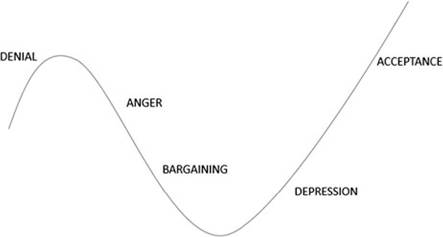
Commonly accepted theory suggest that when you are affected by change, you are likely to experience a series of typical emotional reactions, first simplified in a model by Swiss psychiatrist Elisabeth Kubler-Ross in 1969.1 Brilliantly simple, the Kubler-Ross model works on the most banal changes (e.g. you lost your permanent parking space at work) as well as the most existential (e.g. you have been diagnosed with a potentially lethal disease). It goes roughly like this:
Denial—The first reaction is denial. In this stage individuals believe the news is somehow mistaken, and cling to a false, preferable reality.
Anger—When the individual recognizes that denial cannot continue, they become frustrated. Certain psychological responses of a person undergoing this phase would be: “Why me? It’s not fair!”; “How can this happen to me?”; “Who is to blame?”; “Why would this happen?”.
Bargaining—The third stage involves the hope that the individual can avoid or negotiate mitigations to the rejected change. Usually, the negotiation for an extended status quo is made in exchange for reformation.
Depression—“I’m so sad, why bother with anything?”; “It’s over soon, so what’s the point?” During the fourth stage, the individual becomes saddened by the inevitability.
Acceptance—“It’s going to be okay.”; “I can’t fight it, I may as well prepare for it.”; “Nothing is impossible.” In this last stage, individuals embrace the unavoidable future (Fig. 1).
In my experience, most people swiftly acknowledge the relevance of the model, and it is pretty easy for anyone to think of an example of recent change that triggered a response pattern along the lines of this model. Obviously, any manager implementing change will have to take this pattern into consideration, because organizations consist of real people who will have real feelings about the change affecting them. The manager who can shepherd a team through the emotional rollercoaster is a very valuable asset to his or her organization. Most of Change
1Elisabeth Kubler-Ross: On Death and Dying: What the Dying Have to Teach Doctors, Nurses, Clergy and Their Own Families (1969).
Management theory out there seems to focus on these stages and how to deal with the challenges of each.
Existing Change Management theory is very useful, in fact extremely useful if you have not come across it before, but I still think there is a significant shortcoming when applied to commercial settings like business or law. The Kubler-Ross model and similar adaptations are based on the premise of an inevitable outcome. I.e. painful as it may be to move from denial through acceptance, the change will eventually prevail. Which makes sense when you think about Kubler-Ross studying the field of acceptance of death (which, alas, is inevitable), but certainly is not always the case in business or law, where there frequently is so much resistance that the change fails. In other words, the use of a Kubler-Ross type model in planning change may trick you into thinking that you will be successful in the end—which is simply not true. Which leads me to the main topic of this article.
3